AI Visibility Is Now A Fourth Ranking Factor (And Most Sites Are Failing The Test)

Why Google rankings aren’t enough anymore and what you’re actually losing
The Thing Nobody’s Talking About
Your website ranks fine on Google. Page one for your target keywords. Traffic is steady. Conversions are okay.
But you’re invisible to AI systems.
ChatGPT doesn’t cite you. Perplexity doesn’t pull from your site. Claude doesn’t reference your expertise. And every day, thousands of people are getting answers from AI systems without ever knowing you exist.
This is the visibility gap that’s reshaping search in 2026. It’s not replacing Google rankings. It’s running parallel to them. And it’s costing you traffic you don’t even realize you’re losing.
Here’s what’s happening, why it matters, and how to measure exactly what you’re missing.
There Are Now Four Ranking Factors (Not Three)
For a decade, SEO orthodoxy was clear: rankings, visibility, authority, and relevance. Google’s algorithm. That’s what mattered.
In 2026, there’s a fourth factor running in parallel: AI visibility.
This isn’t theoretical. It’s measurable. Tools now exist that audit what AI systems can actually see on your site—whether language models trust your content enough to cite it, whether you appear in AI-generated answers, whether AI systems even know you exist.
The findings are grim for most websites.
A typical website that ranks on Google can still be completely invisible to AI systems. You’re getting searched but not cited. You’re ranking but not trusted. You’re visible to human searchers but not to the machines that increasingly mediate what information people consume.
And the disparity is widening. As more people use ChatGPT, Claude, Perplexity, and SearchGPT instead of traditional Google searches, sites that aren’t optimized for AI visibility are being systematically bypassed.
What AI Visibility Actually Means
Let’s be specific about what we’re talking about here, because “AI visibility” is a concept that still confuses most business owners.
When someone asks ChatGPT a question, the AI doesn’t browse the web in real-time. It’s trained on data up to a certain date and generates answers based on patterns in that training data. But newer AI systems like Claude and Perplexity do access live web data and can cite sources.
For those systems, visibility means: Is your site structured in a way that AI systems can parse and understand? Is your content authoritative enough that the AI trusts it enough to cite it? Are you appearing in the knowledge graphs and datasets that AI systems pull from?
Most sites fail on all three counts.
Here’s why: traditional SEO optimized for human readers and Google’s ranking algorithm. You structured your content for keyword rankings. You built backlinks for authority signals. You optimized for Core Web Vitals because Google cares about those things.
But AI systems care about different things. They care about entity clarity (does your site make it obvious what your business is and what you specialize in?). They care about llms.txt (a file that tells AI systems what your business does). They care about structured data and knowledge graph optimization. They care about whether your content appears in authoritative sources that AI systems trust.
Most websites haven’t optimized for any of this.
The result: you rank fine on Google but you’re invisible to AI. Your content doesn’t get cited. Your expertise doesn’t get referenced. And every question your ideal customer asks an AI system has a chance to get an answer from someone else — someone who took the time to optimize for AI visibility.
The Data Is Stark
According to industry analysis, 34% of websites still have duplicate meta descriptions, missing title tags, or broken structured data: https://www.semrush.com/blog/ai-citation-visibility-2026. These are foundational SEO elements, but they also matter for AI visibility. A site with sloppy metadata looks untrustworthy to both humans and machines.
Research from Featureon.ai examined which sites ChatGPT, Claude, and Perplexity actually cite: https://featureon.ai/blog/ai-visibility-2026. The results were revealing: sites that appeared in traditional Google results didn’t automatically appear in AI citations. In fact, only about 22% of sites on the first page of Google were consistently cited by AI systems. The other 78% ranked but weren’t trusted enough to cite.
One marketing team analyzed their traffic sources according to Search Engine Land: https://www.searchengineland.com/ai-citations-authority-2026. In 2025, organic search from Google was 58% of their traffic. By mid-2026, it was 42%. Where did the traffic go? AI referrals went from 2% to 28%.
That’s market reallocation happening in real-time.
How To Audit Your AI Visibility (The Right Way)
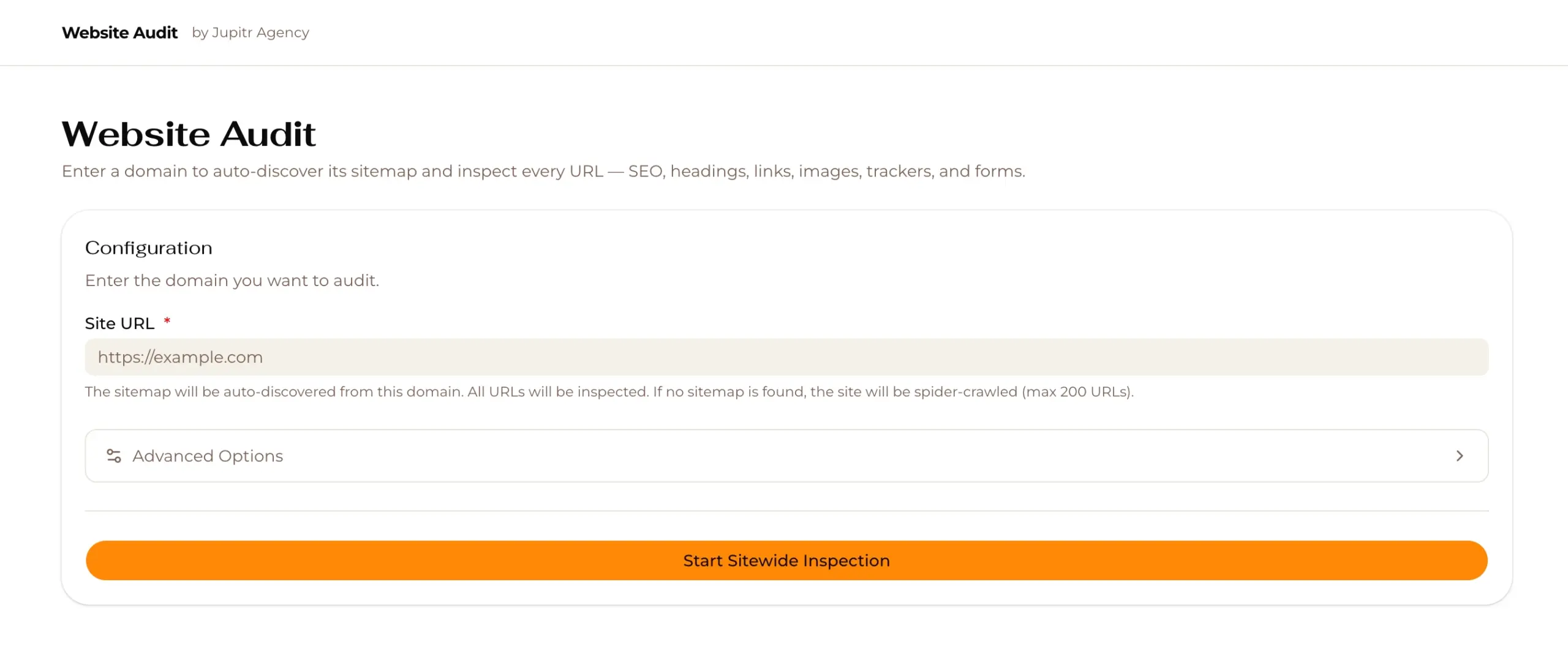
We built an audit tool (audit.jupitragency.com) that does exactly this. It scans your entire site and tells you exactly where you’re failing the AI visibility test.
Here’s what happens when you run an audit:
Crawlability Check
At the top level, it checks:
- Robots.txt status — Can AI systems even access your site?
- Sitemap status — Do you have a proper XML sitemap?
- llms.txt file — The critical file most sites are missing. This tells Claude, ChatGPT, and Perplexity exactly what your business does.
- Other crawlability fundamentals
If any of these fail, AI systems can’t even see your site.
Page-By-Page Audit
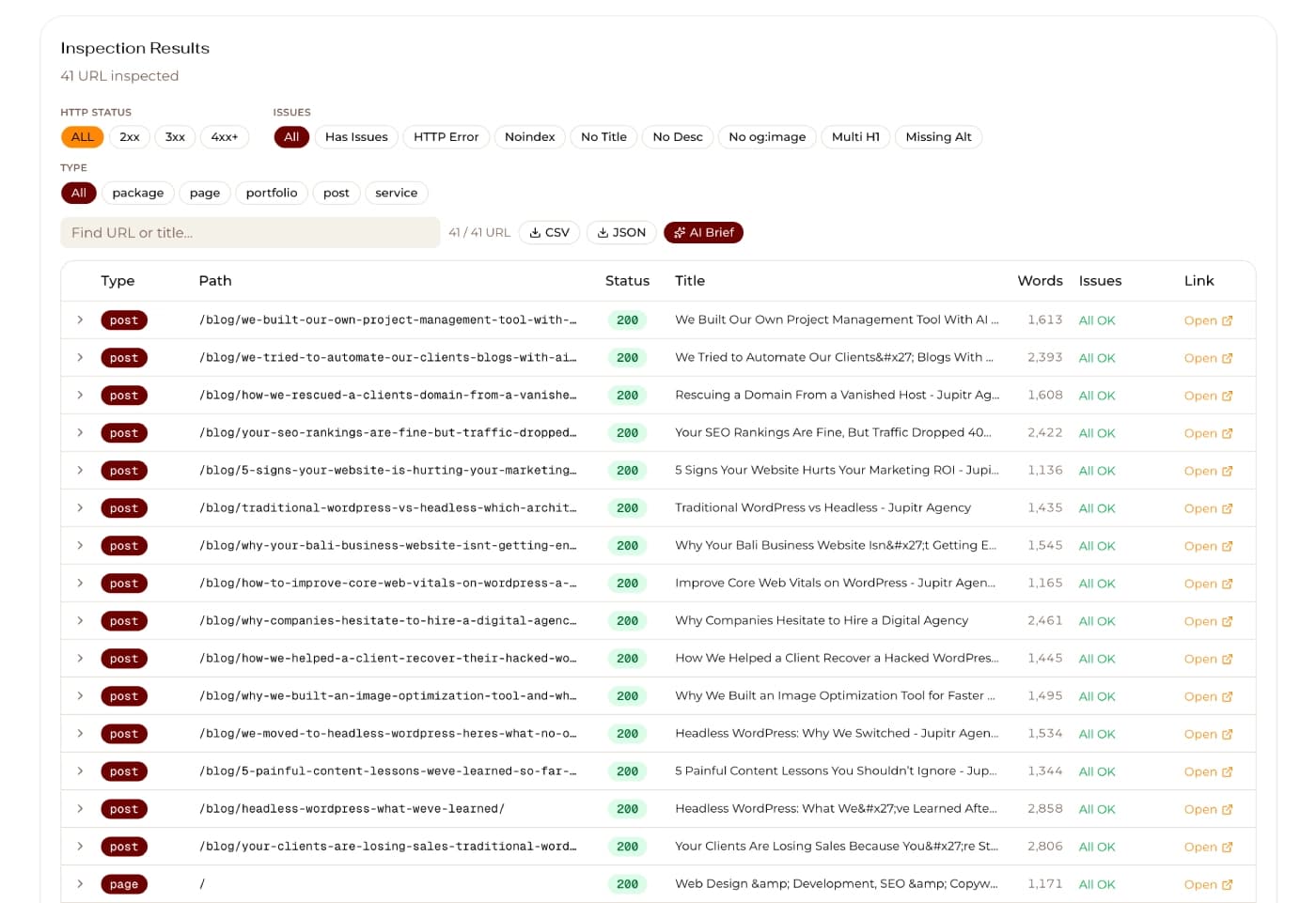
Then it scans every page on your site individually. You get a full inspection report showing:
- 314 URLs inspected (complete scope)
- HTTP status filters (ALL, 2xx success, 3xx redirects, 4xx errors)
- Issue categories: Has Issues, HTTP Error, Noindex, No Title, No Description, No og:image, Multi H1, Missing Alt
- Each page flagged with specific problems
The Three Export Options (The Game-Changer)
At the bottom of your results, you’ll see three export buttons:
1. CSV Button
Download your complete audit as a CSV file. Open in Excel or Google Sheets. Easy to sort, filter, and share with your team. Perfect for tracking progress across multiple pages, prioritizing fixes, and delegating work to different team members.
2. JSON Button
For developers and technical workflows. Machine-readable data you can integrate into your systems, track changes over time, or feed into your development pipeline.
3. AI Brief Button (The Star Feature)
This is the breakthrough. Click AI Brief and download a specially formatted export designed for Claude Code.
Here’s exactly how it works:
Step 1: Click AI Brief button → download the file
Step 2: Open Claude Code
Step 3: Paste the AI Brief content
Step 4: Claude reads the entire audit and generates:
- Complete list of what needs fixing
- Prioritized implementation order
- Exact code for each fix (schema markup, structured data, llms.txt, title tags, etc.)
- A step-by-step implementation plan
Step 5: Your developer executes the plan
Real example:
Your audit shows 47 pages missing proper title tags, 23 pages missing FAQ schema, 12 pages have no meta descriptions, and your llms.txt is missing entirely.
Manually analyzing and planning fixes? 2-3 weeks of work.
Exporting AI Brief to Claude Code? 5 minutes to get the complete implementation plan with all code ready.
Your developer implements in 3-4 days instead of weeks.
What Fixing This Actually Looks Like
For a typical website, it’s:
- Create/update llms.txt (30 minutes)
- Add FAQPage schema to your FAQ sections (1-2 hours)
- Fix crawlability issues (30 minutes to 2 hours)
- Fix title tags and meta descriptions (1-2 hours)
- Optimize entity clarity (2-4 hours)
- Add Organization and type-specific schema (2-4 hours)
Total time: 10-22 hours for a typical 20-50 page site.
Or: Export the AI Brief and hand it to Claude Code. It generates the complete implementation plan and code. Your developer executes in half the time.
One client implemented AI visibility optimization. Within 60 days:
- Claude citations went from 0 to 12+ per week
- Perplexity traffic appeared in analytics (50+ visits/week)
- Google rankings actually improved
- Lead quality improved (AI-referred leads had 15% higher conversion rate)
The Uncomfortable Reality
Google rankings are no longer sufficient. They’re necessary, but not sufficient.
A site that ranks on page one but is invisible to AI systems is leaving massive traffic on the table. Every question asked to ChatGPT, Claude, or Perplexity is a potential customer interaction you’re missing.
What To Do Starting Now
Step 1: Run free audit at audit.jupitragency.com (2 minutes)
Step 2: Review your results. You’ll get a clear inspection report showing which pages have issues.
Step 3: Choose your export. CSV (team collaboration), JSON (dev pipeline), or AI Brief (Claude Code implementation).
Step 4: Implement fixes. Either manually or hand the AI Brief to Claude Code.
Step 5: Monitor the impact. Ask ChatGPT and Claude about your industry. See if you get cited.
Step 6: Re-audit in 60 days. Watch your AI Visibility Score improve.
Two minutes to audit. One minute to export. Two weeks to implement. Measurable impact within 60 days.
That’s the play.
Further Reading
If you want to understand how AI visibility ties into broader search trends:
- “Your SEO Rankings Are Fine But Traffic Dropped 40%. Here’s Why” — We covered AI Overviews and GEO strategy in depth. This article explains why traditional rankings are being displaced by AI-mediated search results.
- “Headless WordPress: What We’ve Learned After Building 18 Websites” — Better structured websites perform better for both Google and AI systems. Architecture matters.
- “We Moved to Headless WordPress — Here’s What No One Tells You” — The structural clarity that comes with headless development also helps with AI visibility. Content architecture is everything.
External resources on AI visibility and GEO:
- “llms.txt is designed to help Large Language Models understand your website”
- “AI Visibility: The New Fourth Ranking Factor in 2026”
- “Knowledge graphs and entity clarity determine AI citation likelihood”
- “22% of Google first-page sites are consistently cited by LLMs”
- “Generative Engine Optimization: SEO for AI-powered search”
- “Structured data and schema markup improve AI readability”
FAQ
Does AI visibility replace Google rankings?
No. They’re complementary. You need both. Google is still the primary search channel for most industries. But AI is growing fast. In 2026, you need to optimize for both channels simultaneously.
How do I know if AI systems are citing my site?
Ask them directly. Use Claude, ChatGPT, or Perplexity and ask questions about your industry. See if your site appears in their responses. Over time, you’ll start seeing AI-referred traffic in analytics tools that track it.
Will this hurt my Google rankings?
No. AI visibility optimization (better structured data, clearer content, llms.txt) also helps Google. Everything you do for AI visibility improves your site’s technical SEO quality. You’ll likely see rankings improve, not decline.
Does this apply to my industry?
Yes. Every industry is seeing the shift toward AI-mediated search. B2B, B2C, services, e-commerce, SaaS — all of them. Businesses in competitive markets where decision-makers use AI tools need to be visible to AI systems.
How long until AI visibility becomes standard?
It’s becoming standard now. Leading agencies and consultants already optimize for it. By 2027, it will be expected, not optional. Now is the window to build a competitive advantage.
Can small businesses compete with large brands on AI visibility?
Actually, yes. AI systems don’t care about brand size. They care about entity clarity, structured data, and original content. A 10-person agency with strong topical authority might be cited more often than a Fortune 500 company with weak content structure.
What’s the AI Brief export for?
The AI Brief is formatted specifically for Claude Code. Download it, paste it into Claude, and Claude generates a complete implementation plan with all the code you need to fix what’s missing. This cuts implementation time from weeks to days.
Do I need to use Claude Code to fix the audit issues?
No. You can use CSV export to manually track and fix issues, or JSON for your dev pipeline. AI Brief is the fastest option if you have Claude Code set up, but all three exports work for different workflows.
Run Your Free AI Visibility Audit
Run a free audit at audit.jupitragency.com and see exactly where you stand. Two minutes. You’ll get:
- Full inspection of 300+ pages
- Clear breakdown of which pages have issues
- Categorized problems (missing titles, no descriptions, schema issues, etc.)
- Export buttons ready to download (CSV, JSON, or AI Brief)
No credit card. No email required initially. Just see where you actually stand.
The gap between where you are now and where you need to be is the traffic you’re leaving on the table. Close that gap and you’ll see AI citations, traffic, and leads you didn’t know were possible.